Premature Baby Baby Loss of Oxygen in the Womb
Contents
- What is preterm labor
- What are the risks of preterm nascency?
- What causes preterm labor
- Can preterm labor be prevented?
- Preterm labor complications
- Causes of premature nascency
- Medical and Pregnancy
- Social, personal and economical
- Behavioral
- Chance factors for preterm labor
- Preterm labor prevention
- Preterm labor signs and symptoms
- Preterm labor diagnosis
- Preterm labor treatment
- If your waters have broken
- If your waters haven't broken
- If you're in preterm labor
What is preterm labor
Preterm labor is labor that happens earlier the 37th week of pregnancy. About 8 out of 100 babies volition exist built-in prematurely. Labor is when regular contractions pb to opening up of the cervix (neck of the womb). This normally occurs at between 37 and 42 weeks of pregnancy. If it occurs before 37 weeks, it is known every bit premature labor. Very premature birth is much less common, with fewer than one in 100 babies beingness born at between 22 and 28 weeks of pregnancy.
Preterm and premature mean the same thing — early. Preterm labor is labor that begins early, before 37 weeks of pregnancy. Labor is the process your body goes through to give nascency to your baby. Preterm labor tin atomic number 82 to premature birth. Premature nascence is when your baby is built-in early, before 37 weeks of pregnancy. Your babe needs about xl weeks in the womb to grow and develop before nascence.
Babies built-in before 37 weeks of pregnancy are called premature. Premature babies can accept serious health problems at nativity and afterward in life. About 1 in x babies is born prematurely each yr in the United States.
- If y'all believe you are having preterm labor, get medical assist right away. If in dubiousness, get checked early.
- Don't worry most mistaking simulated labor for the existent thing. Everyone will be pleased if information technology's a false warning.
If your preterm contractions result in preterm labor, your baby will be born early. The earlier premature birth happens, the greater the health risks for your babe. Many premature babies (preemies) demand special care in the neonatal intensive care unit. Preemies can as well have long-term mental and physical disabilities.
While the specific cause of preterm labor oft isn't articulate, sure risk factors may up the odds of early labor. But, preterm labor tin can also occur in pregnant women with no known risk factors. Yet, it's a practiced idea to know if you're at risk of preterm labor and how you might assist forestall it.
Signs of preterm labor
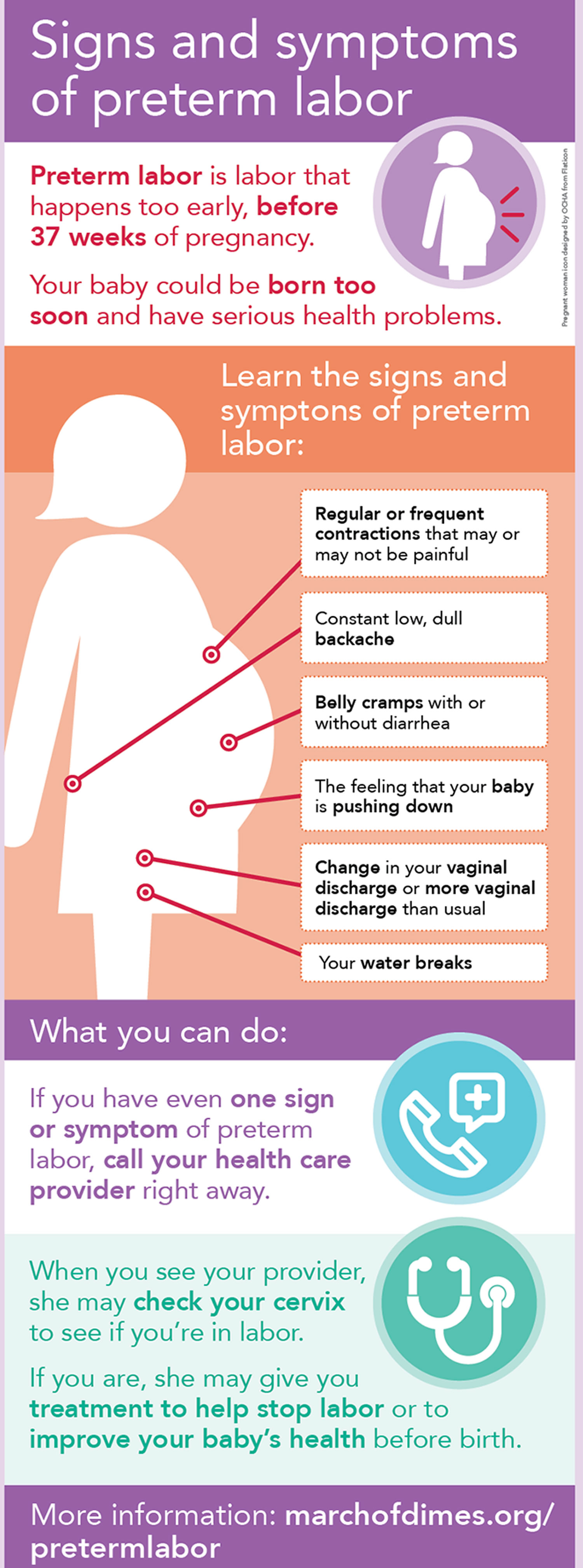
The signs of preterm labor can be similar to the signs of labor that starts at full term, and may include:
- Regular or frequent contractions that make your belly tighten like a fist. The contractions may or may not be painful.
- Period-type pains
- A "prove" (when the plug of mucus that has sealed the neck during pregnancy comes abroad and out of the vagina)
- Change in your vaginal discharge (watery, mucus or bloody) or more vaginal discharge than usual
- Breaking of the waters (rupture of membranes) – this tin exist a gush or a trickle
- Abiding low, dull backache
- Pressure in your pelvis or lower belly, similar your infant is pushing downwardly
- Abdomen cramps with or without diarrhea
If you lot call back your labor (you are having regular, painful tightenings or you think your waters have broken) might exist starting and y'all're less than 37 weeks pregnant, it is important that y'all call your doctor or infirmary maternity unit of measurement directly abroad. Y'all are likely to be asked to come in. They'll need to check you and your baby to find out whether yous're in labor, and discuss your care choices with you.
Your physician or midwife will ask whether you have had a premature nascency in a previous pregnancy. You will also exist asked virtually your general health, whether you lot accept had whatsoever abdominal hurting, tightenings or bleeding, and whether you lot think your waters have broken.
They'll offer checks, tests and monitoring to find out whether:
- your waters take broken
- you're in labor
- you have an infection
You will accept a cheque-upwards that may include:
- a general examination and a check of your temperature, pulse and blood force per unit area
- a vaginal examination, claret test, urine test and cardiotocography to record contractions and your babe's heartbeat
- an examination of your belly
- blood sample to cheque for signs of infection
- urine sample to test for signs of infection
You lot may also be offered an ultrasound scan to bank check your babe's wellbeing and which way circular he or she is lying.
The beginning of labor is usually diagnosed by vaginal examination:
- Your doctor or midwife volition use a speculum (an instrument used to separate the walls of the vagina) to come across whether the cervix is changing in preparation for labor or has already opened up.
- Your doctor or midwife will also be able to run into whether there is fluid leaking, which may betoken that your waters have broken. Sometimes the waters break before 37 weeks just labor doesn't first.
- A vaginal swab may be taken to check for infection.
- Another blazon of swab called fetal fibronectin may be taken from the tiptop of the vagina, if you are at between 24 and 34 weeks of pregnancy. This exam helps to run across whether you are likely to go into labor soon or non:
- Nearly women who are suspected of being in premature labor have a negative swab. This is very reassuring considering fewer than 1 in 100 women with a negative test will become into labor inside the side by side 2 weeks.
- A positive swab ways that at that place is an increased chance you may go into labor. One in five women who have a positive swab go into labor within ten days.
The swab will be less accurate if you have any haemorrhage, if your waters accept broken or if you accept had sexual intercourse in the previous 24 hours.
If labor is not confirmed or if yous take a negative fetal fibronectin swab, you should be able to go abode if you are well and at that place are no concerns for you lot or your baby.
If labor is suspected, you will be brash to stay in hospital. Y'all may be offered:
- A course of two to four corticosteroids injections usually over a 24–48 hr period to help with your baby's evolution and reduce the chance of issues caused by beingness born early on (unless you take already received steroids in this pregnancy).
- A form of antibiotics if information technology is confirmed that your waters take cleaved, to reduce the risk of an infection getting into the womb.
- An opportunity to talk to i of the neonatal squad near the care that your infant is likely to receive, if born early on. You and your partner may also wish to visit the neonatal unit of measurement.
- Medication (tablets or through a drip) to try to stop labor, if your waters accept not broken and there are no concerns about you or your infant. This is just advised in the following circumstances:
- while you are having your class of corticosteroids
- if you need to be transferred to a hospital where at that place is a neonatal intensive care unit of measurement, which could exist some distance away; this is peculiarly the case if yous are less than 32 weeks pregnant.
- These medications are not routinely recommended for women having twins or triplets considering information technology is not clear that they are beneficial in that situation.
- Treatment with magnesium sulfate, through a drip in your arm. This would be considered if you are less than 30 weeks pregnant and likely to give nascency within the next 24 hours. This treatment reduces the chance of complications for your babe, in detail cerebral palsy. You may experience small side effects such as flushing and nausea. If y'all are brash to have this handling, your doctor will hash out information technology fully with you.
Planned premature labor
In some cases, preterm labor is planned and induced because information technology'due south safer for the baby to exist born sooner rather than later.
This could be because of a health condition in the female parent, such as pre-eclampsia, or in the baby. Your midwife and dr. volition discuss with y'all the benefits and risks of continuing with the pregnancy versus your baby being born premature.
You can still brand a nascence plan, and discuss your wishes with your nascency partner, midwife and doctor.
What are the risks of preterm birth?
Babies born before full term (before 37 weeks) are vulnerable to problems associated with premature birth. The earlier in the pregnancy a baby is built-in, the more than vulnerable they are. Premature babies have an increased risk of wellness problems, particularly with breathing, feeding and infection. The earlier your babe is born, the more likely he or she is to take these problems and your infant may need to be looked afterward in a neonatal unit. However, more than than eight out of ten premature babies built-in after 28 weeks survive and only a small number will have serious long-term disability. Many survivors (every bit children) who have long-term health problems withal rate their quality of life as being proficient.
Your goal is to get as close to term (forty weeks) as you lot can before giving nascency. The closer yous get to term, the greater your chances of having a healthy baby. Work with your doctor or obstetrician. Together you can take steps to keep y'all from giving birth too early on.
Babies are considered 'viable' at 24 weeks of pregnancy – this means it's possible for them to survive being born at this stage. If y'all give birth before 24 weeks of pregnancy, it is sadly much less likely that your baby will survive. Babies who do survive later on such a premature birth often take serious health problems. The possible treatment and outcomes for your baby in your individual situation will exist discussed with you.
Premature baby is at risk of a variety of problems, such every bit:
- non breastfeeding well;
- having immature lungs, and not being able to exhale on their own;
- bleeding in the brain;
- life-threatening infections;
- jaundice;
- inflammation of the bowel;
- long-term health issues, such as cognitive palsy; or
- dying.
Babies built-in this early need special intendance in a hospital with specialist facilities for premature babies. This is called a neonatal unit of measurement. They may take health and development problems because they haven't fully developed in the womb.
If your baby is likely to exist delivered early on, you should be admitted to a hospital with a neonatal unit.
Not all hospitals have facilities for the care of very premature babies, and so it may be necessary to transfer you and your baby to another unit, ideally earlier delivery (if fourth dimension permits) or immediately later.
Twins and multiples
Twins and triplets are oft born prematurely. The boilerplate delivery date for twins is 37 weeks, and 33 weeks for triplets.
If you lot take any reason to retrieve that your labor may exist starting early on, contact your hospital straight away.
What causes preterm labor
For well-nigh women, the cause of preterm labor is not found. It is idea that a number of factors, sometimes involving infection, can bring about a change in the neck that causes labor to outset.
However, there are certain factors that increment the risk.
These include if:
- your waters take broken early on
- you accept had a premature nativity or your waters broke before 37 weeks, in a previous pregnancy
- you lot have had a previous tardily miscarriage (after 14 weeks of pregnancy)
- you have had vaginal bleeding afterward xiv weeks in this pregnancy
- you take an abnormality in the shape of your womb
- you are carrying twins or triplets
- you lot have backlog fluid around your baby
- you have a short neck
- you are a smoker
- you have had fertility handling.
Having your baby early on means that you are at an increased risk of having a premature birth in a future pregnancy. However, you lot are still likely to have a baby built-in at more 37 weeks next time.
Yous will be advised to be under the care of a consultant obstetrician who volition talk over with you a programme for your pregnancy. This will depend on your individual situation and on whether a crusade for your early on delivery, such as infection, was found.
Can preterm labor be prevented?
In some circumstances, particularly if y'all have had a babe built-in prematurely or a late miscarriage in the past, you may be offered vaginal scans in pregnancy to measure out the length of your cervix or yous may be advised to take a suture (sew) put effectually it to forbid information technology opening early.
A cervical suture is an performance where a suture (run up) is placed around the neck (neck of the womb). Information technology is also sometimes known as cervical cerclage. It is unremarkably done at between 12 and 24 weeks of pregnancy.
A cervical suture is sometimes recommended for women who are idea to accept a high adventure of a late miscarriage or of going into preterm labor. The purpose of the suture is to reduce the take chances of your baby being born early. Premature babies accept an increased risk of short- and long-term wellness bug.
The exact crusade of preterm labor or late miscarriages is not clear, but they may be caused by changes in the cervix such every bit shortening and opening. A cervical suture helps to keep the cervix long and closed, thereby reducing the risk of premature birth or late miscarriage.
Insertion of the suture takes place in an operating theater. You lot may take a spinal anesthetic where you will stay awake only will be numb from the waist down or you may be given a full general anesthetic where you lot volition be asleep. Your team will advise which would be the all-time option for you.
You will exist advised not to swallow or drink for 4–6 hours before the functioning. In the operating theater, your legs will be put in supports and sterile covers will exist used to proceed the operating area clean. The doc volition then insert a speculum (a plastic or metal instrument used to split the walls of the vagina to evidence or accomplish the cervix) into the vagina and put the suture around the cervix. The performance should take less than xxx minute.
After, you lot may be given antibiotics to aid prevent infection and you will exist offered medication to ease any discomfort. You may also take a tube (catheter) inserted into your bladder that volition be removed once the anesthetic has worn off.
Y'all are likely to be able to go home the aforementioned twenty-four hours although y'all may exist advised to stay in hospital longer.
Afterwards the performance, you volition usually accept some bleeding from the vagina, which should change to brown in color after a day or two. Y'all may have a rising in temperature that should settle without treatment.
In one case you recover from the functioning, you can carry on as normal for the rest of your pregnancy. Resting in bed is not normally recommended. Sexual intercourse may be connected when you feel comfortable to do so. Your dr. can advise you about the activities you can do and those best avoided during the start few days afterwards the process.
Are cervical sutures sometimes inserted through the abdomen?
Yes, if a vaginal cervical suture has non worked in the past or information technology is non possible to insert a vaginal suture. This would involve an functioning through your belly and is called a 'transabdominal cerclage'. It is done either before you become significant again or in early pregnancy. Such a suture is non removed and your baby would be born by caesarean section.
When might a cervical suture exist advised?
Y'all may be in 1 of the following situations:
- If you have had one or two tardily miscarriages or premature births (earlier 34 weeks), you may be offered ultrasound scans between 14 and 24 weeks of pregnancy to mensurate the length of your cervix. If the scans show that it has shortened to less than 25 mm, you lot may be advised to take a cervical suture.
- If yous have suffered iii or more than late miscarriages or three or more premature births y'all may exist advised to have a cervical suture inserted at about 12–fourteen weeks of pregnancy.
During pregnancy it is sometimes noticed during a vaginal test or a routine scan that the cervix has started to open upwardly. Depending on your circumstances, y'all may exist offered a suture called a rescue suture. If yous are in this situation, a senior obstetrician will discuss with you lot the risks and benefits of having a rescue suture.
Are there situations when a cervical suture would not be brash?
Sometimes a cervical suture is not advised. It would non normally meliorate the outcome for your baby/babies and may acquit risks to you in the post-obit circumstances:
- you are more than 24 weeks pregnant
- you are conveying twins or triplets
- your womb is an abnormal shape
- an ultrasound browse washed for another reason happens to show that you lot have a short cervix
- yous take had handling to the cervix for an abnormal smear.
If a suture is not the correct choice for you lot, y'all will still be closely monitored. This may include regular vaginal ultrasound scans to measure the length of your cervix until 24 weeks of pregnancy. If the cervix is shortened, yous may be offered corticosteroid injections after 23 weeks to increment the chance of your baby surviving if built-in early.
Are there situations when a cervical suture would not be put in?
Yep. A cervical suture would not exist put in if:
- you lot are already in labor or your waters have broken
- you have signs of infection in your womb
- yous have vaginal haemorrhage
- in that location are concerns about your baby's wellbeing.
Are there whatsoever risks in having a cervical suture?
In that location is a small chance that your bladder or cervix may be damaged at the time of the performance. Rarely, your membranes may be ruptured. The adventure of complications is higher if you have a rescue suture and this will be discussed with you before the operation.
A planned cervical suture does non increase your risk of infection, miscarriage, or premature labor. Information technology does not increase your risk of having to be started off in labor (be induced) or needing a caesarean section.
Is in that location anything I should look out for?
If you feel any of the following symptoms, yous should contact your motherhood unit:
- contractions or cramping
- vaginal bleeding
- your waters breaking
- smelly vaginal discharge.
How and when volition the suture be taken out?
Your suture will be taken out at the infirmary. This volition normally happen at effectually 36–37 weeks of pregnancy, unless y'all go into labor before then.
You will not normally need an coldhearted. A speculum is inserted into your vagina and the suture is cut and removed. It usually takes just a few minutes.
You may accept a modest amount of bleeding afterwards. Whatsoever red haemorrhage should settle inside 24 hours but yous may take a brown discharge for longer. If you have any concerns, tell your midwife or physician.
If you go into labor with the cervical suture in identify, it is very important to have it removed promptly to prevent damage to your neck. If y'all retrieve you lot are in labor, contact your motherhood unit straight away.
If your waters break early but you are non in labor, the stitch volition usually be removed because of the increased risk of infection. The timing of this volition be decided by the team looking after you.
Preterm labor complications
Many women diagnosed with preterm labor evangelize at or near term. However, there are no medications or surgical procedures to stop preterm labor, once it has started. In some cases, preterm labor associated with issues such as an infection or smoking can be managed by treating the infection or quitting smoking.
Preterm labor could pb to premature nascency. This can pose a number of health concerns, such as low birth weight, breathing difficulties, underdeveloped organs and vision problems. Children who are built-in prematurely also have a higher risk of learning disabilities and behavioral problems.
Causes of premature birth
There are many causes of premature nascency. Most occur spontaneously, however on occasions a female parent or baby may necessitate an early on induction of labor or caesarean birth. This can occur for medical or not-medical reasons.
Common reasons for preterm birth tin exist associated with dissimilar factors including medical and pregnancy; social, personal and economical; and behavioral.
Medical and Pregnancy
Cervical incompetence: This occurs when a weak cervix cannot support the weight of the uterus and begins to dilate (widen) and efface (sparse) before pregnancy has reached term. Occasionally women diagnosed with an incompetent cervix may undergo a process in early stages of pregnancy called a cerclage. This involves placing a stitch in the cervix to foreclose it opening up besides before long and removing the sew together when nearing term.
Multiple births: Occurs when more than one fetus is carried in a single pregnancy. Twins and other multiple births are often induced early on if labor is not spontaneous. Around l% of twin pregnancies will be built-in before 37 weeks and a very high percentage of higher lodge multiples will be born prematurely.
Placental Accreta: Placenta accreta is a general term to draw a serious complexity of pregnancy when part of the placenta, or entire placenta invades and is inseparable from the uterine wall causing astringent blood loss later delivery. After giving nativity the placenta should carve up completely from the uterus. If part or all of the placenta remains attached it is called placenta accreta. It's also possible for the placenta to invade the muscles of the uterus (placenta increta) or abound through the uterine wall, sometimes extending to nearby organs (placenta percreta).
Placenta Previa: A complication of pregnancy where the placenta has attached to the uterine wall shut to or over the opening of the neck. The most mutual complication of placenta Previa is bleeding leading to an increased risk of slow foetal growth and premature birth. Almost all babies are delivered via caesarean birth as the increased gamble of severe bleeding associated with a vaginal birth can be life threatening. A woman is likewise at increased run a risk of having further premature births if this has occurred in previous pregnancies.
Placental abruption: A complication of pregnancy, where the placenta separates from the wall of the uterus. It is the nearly common cause of tardily pregnancy bleeding and if the separation is severe tin can contribute to fetal and maternal death. Direct trauma to the uterus is a known cause, and take a chance factors may be multiple pregnancies, smoking and loftier blood force per unit area including preeclampsia.
Placental insufficiency: This condition tin foreclose the baby from gaining essential nourishment. Symptoms may include beneath average weight gain, beneath average fetal development, or slow growth of the uterus. It can too pb to foetal distress decreasing their heart charge per unit and in serious cases an inability to tolerate a vaginal nativity, thus requiring a caesarean delivery. An ultrasound exam will determine if growth of the foetus is adequate and doctors may advise preterm delivery if necessary. Placental insufficiency can be caused by conditions such as diabetes, high claret pressure or preeclampsia, maternal blood clotting disorders, smoking or taking drugs such as cocaine.
Preeclampsia: A complication of pregnancy where hypertension, loftier blood pressure, occurs in conjunction with high levels of protein in the urine and oedema. The increases in blood pressure tin can prevent acceptable oxygen reaching the foetus and possibly lead to wellness problems for the baby. Information technology is most common subsequently the 20th week of pregnancy. Risk is increased if the female parent already has high claret pressure, diabetes or kidney disease. Preeclampsia is the most common of the dangerous pregnancy complications and can affect both mother and baby. A variation of preeclampsia is HELLP syndrome, a life threatening liver disorder, too related to hypertension in pregnancy. Information technology is usually diagnosed as a direct result of beingness evaluated for preeclampsia. HELLP is an abbreviation of Hemolytic anemia, Elevated Liver enzymes and Depression Platelet count. Approximately ten% to 20% of women who have severe preeclampsia develop HELLP and the but way to reverse this syndrome is the nascence of the infant to forbid the potential death of both mother and fetus.
Preterm premature rupture of membranes (PPROM): A condition which occurs in pregnancy when the amniotic sac spontaneously ruptures before the onset of labor. This can lead to spontaneous delivery of the babe within hours or tin take weeks until birth. The mother is normally confined to hospital to monitor the pregnancy and forbid complications. There may be no known crusade or it could be related to risk factors such as an infection, lower socioeconomic conditions where it is more than mutual adequate antenatal care has not been received, vaginal bleeding from conditions such as placental abruption and smoking.
Previous premature birth: Women who accept had a premature commitment previously have an increased take chances of having another pre-term delivery.
Having a family history of premature birth. This ways someone in your family (similar your female parent, grandmother or sister) has had a premature infant. If yous were born prematurely, you're more likely than others to give birth early.
Serious or an existing medical status and other reasons: Weather such every bit rhesus negative blood group, gestational diabetes, diabetes, kidney affliction and high blood pressure tin can all affect a developing babe. In some cases, the conclusion to deliver a baby prematurely is because either they or the mother are medically unwell due to a health problem, congenital abnormality or surgical need.
Twin to twin transfusion syndrome (TTTS): A complication where ii or more fetuses share a mutual placenta and associated with high morbidity and mortality.
Urine infection: Sometimes during the middle to later months of a pregnancy a serious uterine infection can trigger preterm labor. It is important that any possible urine infection be brought to the attention of your health care professional.
Uterine abnormalities: Women with an abnormally shaped uterus such every bit a bicornuate uterus could be at risk of preterm labor. The baby may have less room to grow and when there isn't plenty room for the baby, the stretching of the uterus tin can cause labor to begin.
Connective tissue disorders, like Ehlers-Danlos syndromes (also called EDS) and vascular Ehlers-Danlos syndrome (likewise called vEDS). Connective tissue is tissue that surrounds and supports other tissues and organs. Ehlers-Danlos syndromes can cause joints to be loose and like shooting fish in a barrel to dislocate; skin to exist sparse and hands stretched and hobbling; and blood vessels to be fragile and small. Information technology too can touch your uterus and intestines. Vascular Ehlers-Danlos syndrome is the virtually serious kind of Ehlers-Danlos syndromes considering information technology tin can cause arteries and organs (like the uterus) to rupture (flare-up). Ehlers-Danlos syndromes and vascular Ehlers-Danlos syndrome are genetic conditions that tin be passed from parent to kid through genes.
Being pregnant with a baby who has certain birth defects, like heart defects or spina bifida. Nativity defects are health weather condition that are present at birth. They alter the shape or function of i or more parts of the body. Nascency defects can cause problems in overall health, how the torso develops or how the body works. Spina bifida is a birth defect of the spine.
Thrombophilias. These are atmospheric condition that increase your hazard of making abnormal blood clots.
Getting significant over again too soon later having a babe. For most women it's all-time to look at to the lowest degree 18 months before getting significant again. Talk to your provider near the right amount of time for you.
Social, personal and economic
Female parent'south Historic period: Younger than 17 years or over 35 years
Lower socioeconomic situations: even afterward assessing other variables such as maternal age, race, behavioral problems and medical situations, low income and social disadvantages lead to higher rates of premature birth. Studies continue to decide optimal ways to address this event.
Race: there is a greater risk of women of African descent to take premature births. This hazard is seen to exist as much as five times more than than Caucasian women despite similar health care provision.
Behavioral
Substance employ and abuse: This includes smoking, drinking alcohol or using illicit drugs. The utilise of some substances can atomic number 82 to decreased oxygenation to the fetus and small for gestational age babies, nascence defects and sadly fetal death if a baby is not delivered in fourth dimension to forbid irreversible complications.
Late antenatal care: Situations that can potentially atomic number 82 to premature nativity can be better treated if early antenatal care is sought.
Stress: Certain hormones and proteins in the blood that help control the contraction of the uterus and the production of infection fighting cells are increased in times of stress. These tin lead to increased risk of infections, uterine irritability and thereby increasing the risk of premature birth.
Take a chance factors for preterm labor
Preterm labor can affect whatsoever pregnancy and many women who accept preterm labor take no known take chances factors. Many factors have been associated with an increased take a chance of preterm labor, withal, including:
- Previous preterm labor or premature nativity, particularly in the most recent pregnancy or in more one previous pregnancy
- Pregnancy with twins, triplets or other multiples
- Certain problems with the uterus, cervix or placenta
- A lack of prenatal medical care
- Smoking cigarettes or using illicit drugs during pregnancy
- Sure infections, particularly of the genital tract, such as urinary tract infections or vaginal infections (east.g. bacterial vaginosis)
- Some chronic conditions, such equally loftier blood pressure, diabetes or clotting disorders
- Being underweight or overweight before pregnancy, or gaining too little or too much weight during pregnancy
- Stressful life events, such every bit the expiry of a loved one
- Red blood cell deficiency (anemia), particularly during early pregnancy
- As well much amniotic fluid (polyhydramnios)
- Pregnancy complications, such as preeclampsia
- Vaginal haemorrhage during pregnancy
- Presence of a fetal birth defect
- Little or no prenatal care
- An interval of less than six months since the last pregnancy
- Stress
- Being under 17 or over 35 years one-time
Also, having a short cervical length or the presence of fetal fibronectin — a substance that acts like a mucilage between the fetal sac and the lining of the uterus — in your vaginal discharge has been linked to an increased risk of preterm labor.
While some past research suggested that glue affliction might be linked with premature birth, treatment of periodontal disease during pregnancy hasn't been proved to reduce the take chances of premature nativity.
Preterm labor prevention
Yous might not be able to forestall preterm labor — but at that place'south much you tin practise to promote a salubrious, full-term pregnancy. For instance:
- Seek regular prenatal care. Prenatal visits tin help your health care provider monitor your health and your baby's wellness. Mention any signs or symptoms that concern yous, fifty-fifty if you think they're giddy or unimportant. If you lot have a history of preterm labor or develop signs or symptoms of preterm labor, you might need to meet your wellness care provider more than oft during pregnancy for exams and tests.
- Eat a healthy diet. During pregnancy, you'll demand more folic acid, calcium, iron and other essential nutrients. A daily prenatal vitamin — ideally starting a few months before conception — tin aid fill any gaps.
- Avert risky substances. If yous smoke, quit. Smoking might trigger preterm labor. Illicit drugs are off-limits, besides. In addition, medications of whatsoever type — fifty-fifty those available over-the-counter — deserve caution. Get your health care provider's OK earlier taking any medications or supplements.
- Protect yourself from infections. Talk to your provider almost vaccinations that tin help protect you lot from certain infections. Wash your easily with soap and water subsequently using the bathroom or blowing your nose. Don't eat raw meat, fish or eggs. Have condom sex. Don't impact cat poop.
- Be cautious when using assisted reproductive technology (ART). If you're planning to use Fine art to get pregnant, consider how many embryos will be implanted. Multiple pregnancies carry a higher risk of preterm labor.
- Expect at least xviii months between giving birth and getting meaning again. Use nascence control until you're ready to get significant over again. If you're older than 35 or you've had a miscarriage or stillbirth, talk to your provider nigh how long to await between pregnancies. Miscarriage is the death of a baby in the womb earlier 20 weeks of pregnancy. Stillbirth is the death of a baby in the womb after 20 weeks of pregnancy.
If your wellness care provider determines that you're at increased risk of preterm labor, he or she might recommend taking additional steps to reduce your take a chance, such as:
- Taking preventive medications. If you have a history of premature nascency, your health care provider might suggest weekly shots of a form of the hormone progesterone chosen hydroxyprogesterone caproate (Makena) during your second trimester. In additional, your dr. might offering progesterone, which is inserted in the vagina, as a preventive measure confronting preterm nascence.
- Limiting certain physical activities. If you're at chance of preterm labor or develop signs or symptoms of preterm labor, your wellness care provider might suggest avoiding heavy lifting or spending likewise much time on your feet.
- Managing chronic weather. Sure atmospheric condition, such every bit diabetes and high blood pressure, increase the risk of preterm labor. Work with your health intendance provider to keep whatsoever chronic weather condition under control.
If you have a history of preterm labor or premature birth, y'all're at take a chance of a subsequent preterm labor. Work with your health care provider to manage whatsoever risk factors and reply to early on warning signs and symptoms.
Preterm labor signs and symptoms
For some women, the signs and symptoms of preterm labor are unmistakable. For others, they're more subtle.
If you have any of the following symptoms, contact your doctor or midwife straight away, every bit yous could be in labor:
- either a ho-hum trickle or a gush of clear or pinkish fluid from your vagina or whatsoever increment in vaginal discharge
- constant low, dull backache
- cramps similar potent catamenia pains
- regular or frequent painful contractions — a tightening sensation in the belly
- mild abdominal cramps
- a frequent need to urinate
- a feeling of pressure level in your pelvis or lower abdomen (feeling that the baby is pushing down)
- vaginal spotting or bleeding
- a alter in vaginal discharge – watery, mucous, or bloody vaginal discharge
- nausea, vomiting or diarrhea
- four or more than contractions per hour
- bleeding or claret spotting after 3 months into your pregnancy
Don't delay if you have strong pain, a smelly discharge or bleeding from your vagina, or if you lot are feeling feverish, sick or have a temperature, call immediately every bit you may need urgent medical attention.
- Don't worry about mistaking false labor for the real matter. Everyone will be pleased if information technology's a simulated alarm.
You may have some of the symptoms but not others. For instance, your waters may take broken but with no contractions, or vice versa. Contractions don't always indicate that y'all're in labor, so your healthcare team volition comport out checks to find out.
Many women experience Braxton Hicks, sometimes known every bit practice contractions. These can become quite strong and painful during the third trimester, and it'south easy to fault them for the real thing.
The healthcare team volition check
- whether you are really in labor
- if labor hasn't started, whether your symptoms are due to some other cause that needs treating
- if you are definitely in labor, whether this has been caused past something (such as an infection) that needs treating, and how far the labor is progressing, and so they can line up the facilities you need, either to delay the birth or to evangelize the baby.
Preterm labor diagnosis
To help diagnose preterm labor, your health care provider will certificate your signs and symptoms. If you're experiencing regular, painful contractions and your cervix has begun to soften, thin and open before 37 weeks of pregnancy, y'all'll likely be diagnosed with preterm labor.
Tests and procedures to diagnose preterm labor include:
- Pelvic test. Your health care provider might evaluate the firmness and tenderness of your uterus and the babe's size and position. He or she might also do a pelvic examination to determine if your cervix has begun to open — if your h2o hasn't broken and the placenta isn't covering your cervix (placenta previa).
- Ultrasound. An ultrasound might be used to measure the length of your cervix and determine your baby's size, age, weight and position in your uterus. Yous might need to exist monitored for a period of time and then have another ultrasound to measure any changes in your cervix, including cervical length.
- Uterine monitoring. Your health care provider might use a uterine monitor to measure the duration and spacing of your contractions.
- Lab tests. Your wellness care provider might take a swab of your vaginal secretions to check for the presence of certain infections and fetal fibronectin — a substance that acts like a gum between the fetal sac and the lining of the uterus and is discharged during labor. Even so, this test isn't reliable plenty to exist used on its ain to assess the risk of preterm labor.
- Maturity amniocentesis. Your health care provider might recommend a procedure in which amniotic fluid is removed from the uterus (amniocentesis) to decide your babe's lung maturity. The technique can likewise be used to observe an infection in the amniotic fluid.
If you're in preterm labor, your wellness intendance provider will explicate the risks and benefits of trying to end your labor. Keep in listen that preterm labor sometimes stops on its own.
Preterm labor treatment
If your waters have broken
Your unborn baby lies in an amniotic sac of fluid or 'waters'. 'Waters breaking' means that the sac has ruptured or cleaved. Your waters normally break effectually the fourth dimension labor is due but in around 2% of pregnancies they break early on for various reasons.
If your waters break before your baby has reached full term (37 weeks), the medical proper noun for it is preterm prelabour rupture of the membranes, or PPROM. If this happens early, before the contractions start, information technology can (but does non always) trigger early on labor.
If your waters accept broken early, you lot will experience it as a trickle or a gush of water from your vagina. It is likely to proceed leaking once it has started. If it isn't too heavy you can use a germ-free towel to catch it. This will also permit you to see what color it is, which will exist helpful data for health professionals. Information technology may be pinkish if it contains some blood, or it may exist clear. If it light-green or chocolate-brown get to the maternity unit as soon equally possible. If it is heavy, you may need to use a towel.
Does it hurt when my waters break?
No it shouldn't hurt when your waters break or when they are broken for yous. The amniotic sac, which is the office that 'breaks' doesn't accept pain receptors, which are the things that crusade you lot to feel pain when you get a cut for example.
You are likely to have an internal examination. This will allow the medico to wait at your neck and bank check:
- if the leaking fluid is amniotic fluid
- if information technology is changing in grooming for labor
- to check for infection by taking a swab.
You might have an ultrasound browse to estimate the amount of fluid left around your baby.
If but a very modest amount of amniotic fluid leaks, information technology is not always easy to be sure whether your waters have broken.
- You may exist advised to article of clothing a pad and stay in hospital for a few hours to monitor the situation.
- If you get home but continue to leak fluid at home, y'all should return to the hospital again.
If your waters are shown to have cleaved, you volition be advised to come into hospital for at least 48 hours. You and your unborn infant will be closely monitored for signs of infection. This volition include having your temperature and pulse taken regularly, and your baby'southward heart rate volition also be monitored.
What are the risks if my waters pause early (PPROM)?
If your waters suspension early the risks and treatment are dependent on the stage of pregnancy yous are at.
- You lot are at risk of going into preterm labor – the health risks for the baby of early on birth are greater the younger they are.
- If yous practice not go into labor, you and the baby are at risk of infection.
The doctors take to balance these 2 considerations. If the waters have broken because of infection, you and the infant have a high adventure of getting the infection and you may need to deliver sooner to forbid this.
If the waters accept broken but there is no infection currently present, you lot and the baby are still at gamble just the immediate run a risk is lesser and your treatment will depend on your stage of pregnancy.
- If you are under 24 weeks of pregnancy and the infant is born, sadly, it is unlikely the baby will survive.
- If you are over 30 weeks and the baby is built-in, the likelihood of your baby surviving is much higher – over 95%.
If your waters accept cleaved there's an increased adventure of infection for you and your baby. Yous'll be offered:
- antibiotics to take for a maximum of 10 days, or until labor starts – whichever is sooner
- tests for infection, which may include blood and urine tests
Figure one. Preterm labor – pre-labor rupture of membranes (P-PROM)
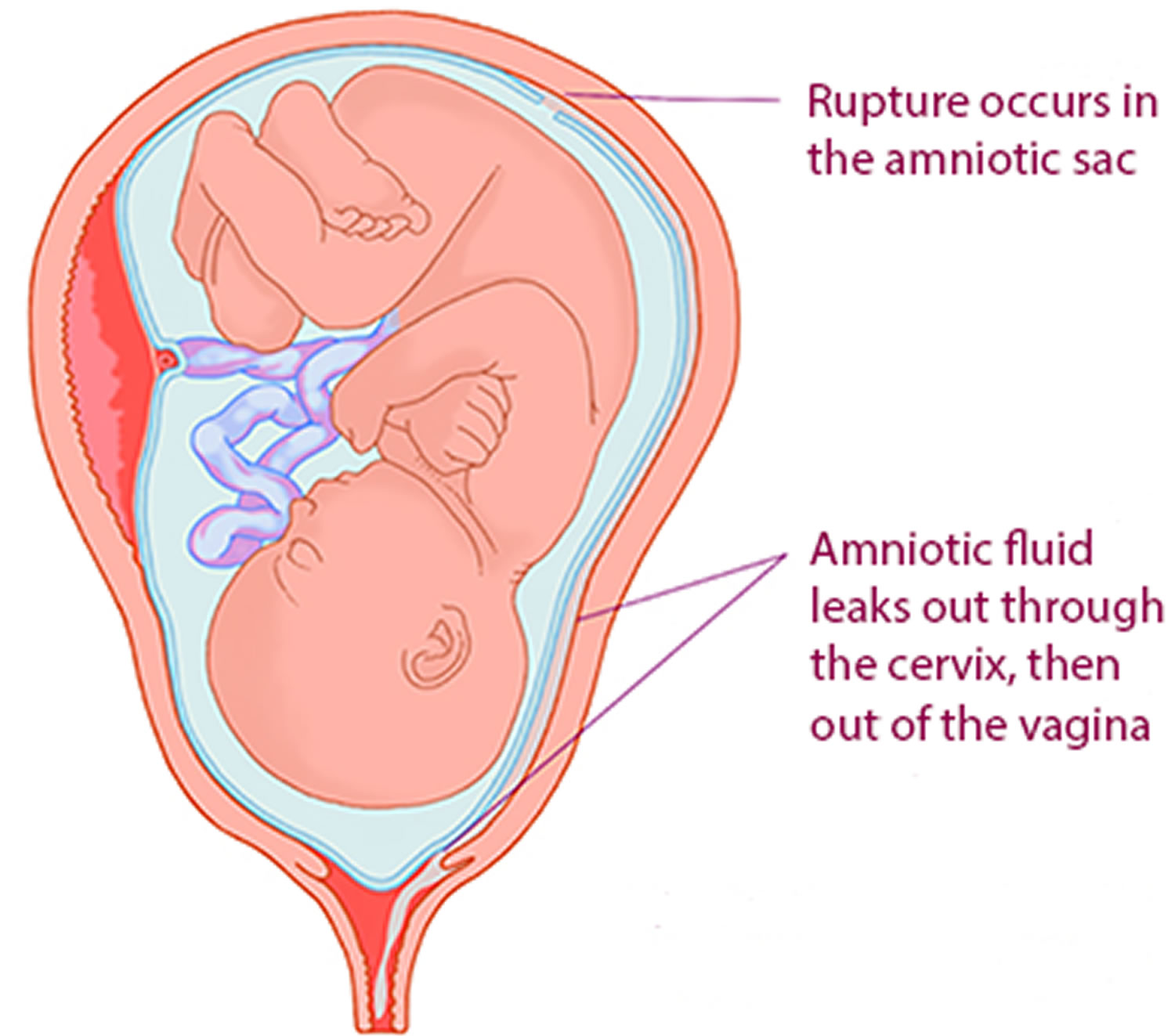
Preterm pre-labor rupture of membranes (P-PROM) doesn't definitely mean you lot're going into labor. You may be able to go home if there's no infection and you don't become into labor inside 48 hours.
If you go home, you'll be advised to tell your midwife immediately if:
- your temperature is raised (a raised temperature is ordinarily over 99.five °F (37.5 °C) but check with your midwife – they may demand you to phone call before it gets to 99.five °F (37.5 °C). You should take your temperature every four hours when yous're awake
- any fluid coming from your vagina (chosen vaginal loss) is colored or smelly
- y'all bleed from your vagina
- your baby'south movements tedious downwardly or cease.
Y'all should avert having sexual intercourse.
Contact your doctor or midwife and return to the hospital immediately if you have:
- a raised temperature (more than 98.6 °F or 37 °C)
- flu-like symptoms (feeling hot and shivery)
- vaginal bleeding
- if the leaking fluid becomes light-green or evil-smelling
- contractions
- abdominal hurting
- if you are worried that the baby is non moving as normal.
Inducing labor or preterm labor with PPROM
If you are past 34 weeks the doctor will weigh upward the benefits of inducing labor before the due date to avoid the take chances of infection with the disadvantages of existence born premature, and may brand a recommendation for early on commitment.
Yous may demand to stay in a hospital that has a neonatal unit and be monitored carefully for whatsoever sign of infection. You may besides exist treated with antibiotics, corticosteroids and magnesium sulfate (if you are less than thirty weeks) to assistance gear up your baby in example the are born prematurely.
Over eighty% of women who have pre-labor rupture of membranes (PPROM) evangelize their babe within seven days of their waters breaking.
Causes of waters breaking early (PPROM)
Intrauterine infection is present in around a third of women with pre-labor rupture of membranes (PPROM). In many cases all the same it happens without any infection being present. The reason for these cases is unclear, however it has been linked to heavy smoking (more than x cigarettes a day) in pregnancy.
What if there are no waters left in my womb?
Your baby's amniotic sac has to have the right amount of amniotic fluid for the pregnancy to proceed normally. If there is a break in the waters your baby volition continue to produce amniotic fluid.
Before 23 weeks, the baby needs 'waters' to be present for their lungs to develop normally. Loss of water earlier this tin pb to severe problems with lung development that can be critical after nativity. After 23 weeks your baby does not need the amniotic fluid and so much, so low levels of fluid may non be a problem in itself, only if the low levels are due to your waters breaking and so there is a risk of infection.
If your waters oasis't broken
Your midwife or doctor should discuss with y'all the symptoms of preterm labor and offering checks to see if you're in labor. These checks tin can include asking you lot about your medical and pregnancy history, and near possible labor signs, such equally:
- contractions – how long, how strong and how far apart they are
- any hurting
- vaginal loss, such as waters or a bear witness
You may exist offered a vaginal examination, and your pulse, blood pressure and temperature may besides be checked.
Your midwife or doctor will also check your baby. They'll probably feel your crash-land to find out the baby's position and how far into your pelvis the infant'due south head is.
They should also ask about your baby's movements in the last 24 hours. If they don't ask, tell them well-nigh the babe's movements.
If y'all're in preterm labor
The midwife or doc may offer:
- medicine to try to ho-hum downward or stop your labor (tocolytic). Examples of this are magnesium sulphate, terbutaline and nifedipine.
- corticosteroid injections, which tin help your baby's lungs
Tocolytics
Your health care provider might give you a medication called a tocolytic to temporarily end your contractions. These medications won't halt preterm labor for longer than 2 days because they don't accost the underlying cause of preterm labor. However, they might filibuster preterm labor long plenty for corticosteroids to provide the maximum benefit or, if necessary, for you to exist transported to a facility that can provide specialized intendance for your premature infant.
Your health care provider can assistance y'all weigh the risks and benefits of using a tocolytic. In addition, your health care provider won't recommend a tocolytic if you have certain conditions, such equally pregnancy-induced high blood pressure.
What side effects can tocolytics crusade?
Several kinds of tocolytics may be used during preterm labor, each with unlike side furnishings.
Beta-adrenergic receptor agonists, like terbutaline. Possible side effects for your baby may include having a fast heartbeat. Possible side furnishings for you may include:
- Chest pain; fast or irregular heartbeat
- Breathing problem; fluid in the lungs
- Diarrhea, nausea (feeling sick to your stomach), throwing upwardly
- Feeling giddy; shaking or feeling nervous; seizures
- Fever, headache
- High blood carbohydrate
- Low claret pressure; depression blood potassium
Calcium channel blockers, like nifedipine. There are no side furnishings for your baby. Possible side furnishings for y'all may include:
- Constipation, diarrhea, nausea
- Feeling light-headed or faint
- Headache
- Low blood pressure
- Redness of the skin
Magnesium sulfate. Side effects for your babe may include:
- Being tired and drowsy
- Slowed animate
- Weak muscles
- Low levels of calcium and bone issues, if the drug is used for more than v to seven days.
Side effects for you may include:
- Animate problems, fluid in the lungs
- Dry mouth
- Fatigue (beingness very tired), weak muscle
- Headache, double vision, slurred speech communication
- Heart attack
- Nausea or throwing up
- Redness of the skin, heavy sweating
Nonsteroidal anti-inflammatory drugs (as well chosen NSAIDs), like indomethacin. Side furnishings for your baby may include:
- Haemorrhage in the brain or heart
- Patent ductus arteriosis, also called PDA. This is a heart trouble that'south mutual in premature babies.
- Jaundice. This is a mutual status caused by the build-up of a substance called bilirubin in the blood that makes a baby'southward skin and the white parts of his eyes expect yellowish.
- Kidney issues, like making too little urine
- Necrotizing enterocolitis (besides chosen NEC). This is a problem in a infant's intestines.
- Ascension blood pressure in the lungs
Side effects for y'all include:
- Feeling dizzy
- Heartburn
- Nausea or throwing up
- Oligohydramnios. This is when yous take too picayune amniotic fluid. Amniotic fluid is the fluid that surrounds your baby in the womb.
- Bloated tum lining
- Vaginal bleeding
Slowing downwardly labor or stopping it isn't appropriate in all circumstances – your midwife or doctor tin can discuss your state of affairs with you. They will consider:
- how many weeks pregnant you are
- whether it might be safer for the baby to be built-in – for example, if you have an infection or you're bleeding
- local neonatal (newborn) care facilities and whether you might demand to be moved to another hospital
- your wishes
Corticosteroid injections tin help your baby's lungs get ready for breathing if they're born prematurely. In that location are two injections, given 12 hours apart – your midwife or doctor volition hash out the benefits and risks with you. A unmarried course of corticosteroids has been shown to assistance with a infant's development and therefore volition increase the gamble of your baby surviving, once born. Corticosteroid injection also lessens the chance of your babe having serious complications afterwards nativity such equally breathing bug attributable to the lungs not being fully developed, haemorrhage into the encephalon, serious infection or bowel inflammation.
Corticosteroids probably won't be offered after 36 weeks as your babe's lungs are likely to be ready for breathing on their ain.
If you're in premature labor and you lot're betwixt 24 and 29 weeks pregnant you should be offered magnesium sulfate. This can help protect your baby'southward brain development. You lot may also exist offered it if yous're in labor between 30 and 34 weeks. This is to protect your baby against problems linked to beingness born also before long, such as cerebral palsy.
Can corticosteroids harm me or my infant?
A single course of two to four injections is considered to be condom for you and your babe. More evidence is needed to say whether two or more courses of corticosteroids during pregnancy are safe for your baby.
At what stage of pregnancy should corticosteroids be given?
Corticosteroids help most if they are given to you between 24 weeks and 34 weeks plus 6 days of pregnancy. If you lot are having a planned caesarean department between 35 and 38 weeks plus 6 days, corticosteroids are unremarkably recommended. Corticosteroids may be given before than 24 weeks, but the evidence that they will exist helpful for your baby in that state of affairs is less clear; your obstetrician doctor will discuss this with you.
How long are corticosteroids effective for?
Corticosteroids are of virtually aid if the last dose is given to you between 24 hours and ane calendar week before y'all accept your baby. At that place may still be benefit even if your baby is born within 24 hours of the first dose.
Who should be given corticosteroids in pregnancy?
You may be advised to have corticosteroids if there is an increased chance that your baby volition be born earlier 35 weeks of pregnancy.
This includes:
- if you are in preterm labor
- if yous are suspected to be in preterm labor but this has not been confirmed nonetheless
- if your waters intermission even if you are not having contractions
- if it may benefit your baby to be delivered early on, for example if your infant is not growing
- if information technology may benefit you to have your baby early, for example if yous are seriously unwell, are bleeding heavily or accept severe pre-eclampsia.
If you are having a planned caesarean section before 39 weeks of pregnancy, corticosteroids are recommended to lessen the chance of breathing problems for your baby. If y'all take diabetes or gestational diabetes, yous may need to be in infirmary since corticosteroids increase the claret saccharide level.
When are corticosteroids not necessary?
Giving handling simply in case an event occurs is known every bit condom treatment. If yous accept previously had a baby born early on, have a multiple pregnancy or have had handling to your neck (entrance to the womb), prophylactic treatment with corticosteroids early on in pregnancy is non recommended because in that location is no show that it will assistance your infant.
Are there any circumstances where yous wouldn't be able to take corticosteroids?
Corticosteroids can suppress the mother's immune system, only at that place is no evidence that a single course of corticosteroids will cause harm even if you have a severe infection. If you or your babe are unwell, corticosteroids will usually be started only commitment of your baby will not be delayed to allow you lot to consummate the course.
Source: https://healthjade.com/preterm-labor/
0 Response to "Premature Baby Baby Loss of Oxygen in the Womb"
Postar um comentário