When Can a Motorcyclist Use a Complete Traffic Lane?
Ride Within Your Abilities
Basic Vehicle Control
This manual cannot teach you how to control direction, speed or balance. That is something you tin learn but through practice. But command begins with noesis of your abilities and to ride within them, along with knowledge of the rules of the road.
Body Position
To command a motorcycle well:
- Posture—Sit so y'all can employ your arms to steer the motorcycle rather than to hold yourself up.
- Seat—Sit down far enough forward so that arms are slightly bent when you hold the handle grips. When you bend your arms it permits y'all to press on the handlebars without having to stretch.
- Hands—Hold the handle grips firmly to keep your grip over crude surfaces. Start with your correct wrist flat. This will help you keep from accidentally using too much throttle. As well, suit the handlebars and so your hands are even with or beneath your elbows. This permits you to use the proper muscles to steer with precision.
- Knees—Keep your knees against the gas tank to help you keep your residuum as the motorbike turns.
- Feet—Keep your feet firmly on the Human foot pegs to maintain balance. Do not drag your feet. If your pes catches on something, y'all can be injured and it could impact your control of the motorcycle. Keep your feet most the controls so you lot can get to them fast . Too, practise non let your toes point down—they may get caught between the road and the foot pegs.

Gear Shifts
There is more when you lot change gears than a simple smooth pickup of speed.
The power to use the gears when you lot downshift, plow or first on hills is important for condom motorcycle operation.
Shift downwards through the gears with the clutch as yous tiresome or terminate. Remain in first gear while you are stopped and then that you tin move out apace if you need to.
Brand certain you are riding slowly plenty when you shift into a lower gear. If not, the motorbike will lurch, and the rear wheel may skid. When y'all ride downhill or shift into outset gear you may need to apply the brakes to boring plenty earlier you downshift safely. Work toward a smooth, even clutch release, peculiarly when y'all downshift.
Information technology is all-time to change gears earlier yous enter a turn. However, sometimes a shift while in the turn is necessary. If and then, a sudden alter in ability to the rear bike can cause a slip.
Brakes
Your motorcycle has two brakes: one each for the forepart and rear wheel. Apply both of them at the aforementioned time. The front brake is more powerful and can provide at least three-quarters of your total power to finish. The front restriction is condom to use if you utilize information technology properly. Remember:
- Use both brakes every time you tiresome or stop. When you employ both brakes for fifty-fifty "normal" stops it will permit you to develop the habit or skill of using both brakes properly in an emergency. Squeeze the front restriction and press down on the rear. If you grab at the front end brake or jam downward on the rear, you can cause the brakes to lock. This results in control bug.
- If yous know the technique, you tin apply both brakes in a plough, although it should be done very carefully. When you lean on the motorcycle some of the traction is used for when you corner. Less traction is available for stopping. A slip tin can occur if y'all utilise likewise much brake. As well, if you employ the front brake incorrectly on a slippery surface, information technology can be hazardous. Utilize caution and squeeze the brake lever, never grab.
- Some motorcycles take integrated brake systems that link the front and rear brakes together when you apply the rear brake pedal. (Consult the owner manual for a detailed explanation on the operation and utilize of these systems.)
Turns
Riders oft try to take curves or turns also fast. When they cannot agree the turn, they end up in another lane of traffic or off the road. Or, they overreact and brake too hard, which causes a skid and loss of control. Arroyo turns and curves with circumspection.
Use four steps for better control:
- Slow
- Look
- Lean
- Curlicue
Deadening— Reduce speed before the turn. Shut the throttle and, if necessary, utilise both brakes.
LOOK — Look through the turn to where y'all want to go. Plow but your head, non your shoulders, and proceed your eyes level with the horizon.
LEAN—To plow, the motorbike must lean. To lean the motorcycle, printing on the handgrip in the management of the turn. Press left—lean left—go left. Press right—lean right—become right. Higher speeds and/or tighter turns require the motorbike to lean more.
Curl — Roll on the throttle through the turn to stabilize interruption. Maintain steady speed or accelerate gradually through the turn. This will help keep the motorcycle stable.

In normal turns, the rider and the motorcycle should lean together at the same angle.
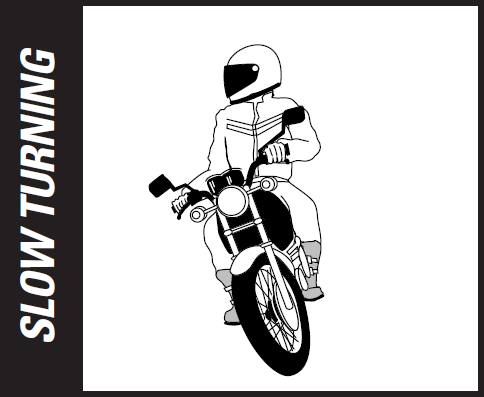
In deadening tight turns, lean the motorcycle only and continue your trunk straight.
 Exam YOURSELF
3. When you ride, you should:
A. Turn your head and shoulders to look though turns.
B. Keep your artillery straight.
C. Keep your knees away from the gas tank.
D. Turn just your head and eyes to expect where you are going.
Answer
Keep Your Distance
The best protection you tin can accept is distance—a "cushion of space"—all around your motorbike. If someone else makes a mistake, altitude permits y'all:
- Time to react.
- Space to maneuver.
Lane Positions
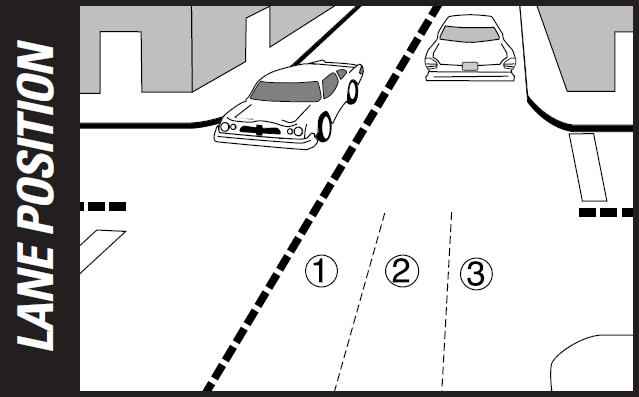
In some ways the size of the motorbike can piece of work to your reward. Each traffic lane gives a motorcycle iii paths of travel, as indicated in the illustration.
Your lane position should:
- Increase your ability to see and be seen.
- Avoid others' bullheaded spots.
- Avoid surface hazards.
- Protect your lane from other drivers.
- Communicate your intentions.
- Avoid wind smash from other vehicles.
- Provide an escape route.
Select the appropriate path to maximize your space absorber and make yourself more than easily seen by others on the road.
In full general, at that place is no single best position for riders to be seen and to maintain a space absorber around the motorcycle. No portion of the lane demand be avoided — including the centre. LANE POSITION
Position yourself in the portion of the lane where you are virtually likely to be seen and you can maintain a space absorber around you. Modify position as traffic situations change. Ride in path 2 or 3 if vehicles and other potential issues are on your left only. Remain in path 1 or 2 if hazards are on your right only. If vehicles are existence operated on both sides of you, the center of the lane, path 2, is usually your all-time option.
The oily strip in the center portion that collects drippings from cars is unremarkably no more than two feet wide. Unless the road is moisture, the boilerplate centre strip permits adequate traction to ride on safely. You tin can operate to the left or right of the grease strip and still exist within the heart portion of the traffic lane. Avert riding on large buildups of oil and grease normally found at busy intersections or price booths.

When Y'all Follow Another Vehicle
"Following too closely" is a major factor in crashes that involve motorcyclists. In traffic, motorcycles demand equally much distance to stop as cars. Normally, a minimum of 2 seconds distance should be maintained behind the vehicle ahead.
To gauge your following altitude:
- Pick out a mark, such as a pavement marking or lamppost, on or well-nigh the road ahead.
- When the rear bumper of the vehicle ahead passes the marker, count off the seconds: "i-thousand-ane, one-thousand-two."
- If you reach the mark before you reach "two," you are too shut. A two-2nd following distance leaves a minimum amount of space to stop or swerve if the driver ahead suddenly stops. It also permits a better view of potholes and other hazards in the road. A larger cushion of infinite is needed if your motorbike will have longer than normal to stop. If the pavement is slippery, if yous cannot run across through the vehicle ahead or if traffic is heavy and someone may clasp in forepart of you, open up a three-second or more altitude. Keep well backside the vehicle alee even when you are stopped. This will make it easier to get out of the way if someone bears down on yous from behind. Information technology volition also give y'all a cushion of space if the vehicle ahead starts to back upwards for some reason. When backside a car, ride where the commuter tin can encounter you in the rearview mirror. Riding in the center portion of the lane should put your paradigm in the middle of the rearview mirror—where a driver is well-nigh likely to see you lot.
Riding at the far side of a lane may allow a commuter to encounter y'all in a side view mirror. Simply remember that about drivers do not look at their side view mirrors nearly as ofttimes as they bank check the rearview mirror. If the traffic state of affairs allows, the center portion of the lane is usually the best place for you to be seen past the drivers ahead and to prevent lane sharing by others.
When You Are Being Followed
Speeding up to lose someone who follows besides closely only ends upward with someone trying to tailgate you at a higher speed. A better mode to handle tailgaters is to get them in front of you lot. When someone follows too closely, change lanes and let them pass. If you cannot do this, slow downwardly and open up extra infinite alee of yous to allow room for both you and the tailgater to terminate. This will too encourage them to pass. If they exercise not laissez passer, you will take given yourself and the tailgater more time and space to react in example an emergency does develop alee.
The Art of Passing and Beingness Passed
When you lot pass or are passed by some other vehicle, it is not much unlike than with a car. Withal, visibility is more disquisitional. Be sure other drivers see you, and that you come across potential hazards.

Passing
- Ride in the left portion of the lane at a safe altitude to increase your line of sight and make you more visible. Signal and bank check for oncoming traffic. Utilise your mirrors and turn your head to await for traffic behind.
- When safe, motility into the left lane and accelerate. Select a lane position that does not crowd the car as y'all pass and provides space to avoid hazards in your lane.
- Ride through the bullheaded spot as apace as possible.
- Signal again, and complete mirror and head checks before you return to your original lane and so cancel signal.
Think, passes must be completed within posted speed limits, and only where permitted. Know your signs and route markings!
Beingness Passed

When you lot are being passed from behind or past a vehicle from the opposite direction, stay in the eye portion of your lane. Riding whatever closer to them could put you in a chancy situation. Avoid being hit by:
- The other vehicle—A slight error by you lot or the passing driver could cause a sideswipe.
- Extended mirrors—Some drivers forget that their mirrors hang out farther than their fenders.
- Objects thrown from windows— Even if the driver knows you're there, a passenger may non encounter you and might toss an object on yous or the road ahead of you.
- Blasts of wind from larger vehicles—They can affect your control. Yous take more room for error if you are in the middle portion when hit by this blast than if you are on either side of the lane.
Practice non movement into the portion of the lane farthest from the passing vehicle. Information technology might invite the other driver to cut back into your lane as well early on.
Examination YOURSELF
4. Usually, a good mode to handle tailgaters is to:
A. Change lanes and let them pass.
B. Use your horn and make obscene gestures.
C. Speed upwardly to put altitude between you and the tailgater.
D. Ignore them.
Answer
When Yous Share a Lane
Cars and motorcycles cannot share a lane safely. Lane sharing is permitted only for ii motorcycles. When you ride betwixt rows of stopped or moving cars in the same lane, information technology tin get out you vulnerable to the unexpected. A hand could come out of a window; a door could open; a auto could plow suddenly. Discourage lane sharing by others. Keep a centre-portion position whenever drivers might be tempted to clasp by you. Drivers are about tempted to do this:
- In heavy, bumper-to-bumper traffic.
- When they want to pass you.
- When you lot gear up to turn at an intersection.
- When y'all move into an exit lane or leave a highway.
When Cars Merge

Drivers on an entrance ramp may not see you lot on the highway. Requite them enough of room. Alter to another lane if ane is open. If in that location is no room for a lane modify, accommodate speed to open upwardly space for the driver making the merge.
Cars Alongside

Do non ride side by side to cars or trucks in other lanes if you do not have to. Yous might be in the bullheaded spot of a car in the next lane, which could switch into your lane without warning. Cars in the next lane also block your escape if yous come upon danger in your own lane. Speed up or drib back to find a place clear of traffic on both sides.
SEE
Good experienced riders remain aware of what is going on effectually them. They improve their riding strategy with SEE, a three-pace procedure used to make appropriate judgments, and apply them correctly in different traffic situations:
- Search
- Evaluate
- Execute
Let'southward examine each of these steps.
Search
Search aggressively ahead, to the sides and behind to avert potential hazards even earlier they ascend. How assertively you search, and how much time and space you lot accept, can eliminate or reduce harm. Focus even more than on finding potential escape routes in or effectually intersections, shopping areas and schoolhouse and structure zones.
Search for factors such as:
- Traffic from the other direction may plough left in front end of you.
- Traffic from the left and right.
- Traffic from backside.
- Chancy road atmospheric condition. Exist especially warning in areas with limited visibility.
Visually "busy" surroundings could hibernate you and your motorcycle from others.
Evaluate
Think nigh how hazards tin can collaborate to create risks for you. Conceptualize potential problems and have a plan to reduce risks.
- Stationary Objects— potholes, guardrails, bridges, telephone poles and trees won't move into your path but may influence your strategy equally you ride.
- Traffic control devices— Look for traffic signals. This includes regulatory signs, warning signs, and pavement mark, to help you evaluate circumstances ahead.
- Other vehicles, pedestrians and animals—may suddenly into your path and increase the likelihood of a crash. Think about your time and space requirements in order to maintain a margin of safety. You must exit yourself fourth dimension to react if an emergency arises.
Execute
Conduct out your decision.
To create more space and minimize harm from any take chances:
- Communicate your presence with lights and/or horn.
- Arrange your speed by accelerating, stopping or slowing.
- Adjust your position and/or direction.
Apply the old adage "one step at a time" to handle ii or more than hazards. Adjust speed to permit two hazards to carve up. So bargain with them one at a time as single hazards. Decision making becomes more than complex with three or more hazards. Weigh consequences of each and give equal distance to the hazards.
In potential loftier risk areas, such every bit intersections, shopping areas, school and construction zones, cover the clutch and both brakes to reduce the fourth dimension you need to react.
Test YOURSELF
5. To reduce your reaction time, you should.
A. Ride slower than the speed limit.
B. Cover the clutch and the brakes.
C. Shift into neutral when slowing.
D. Pull in the clutch when turning.
Answer
Intersections
The greatest potential for disharmonize between y'all and other traffic is at intersections. An intersection can be in the middle of an urban area or at a driveway on a residential street — anywhere traffic may cross your path of travel. Over one half of motorcycle/car crashes are acquired by drivers entering a passenger's correct-of-way. Cars that plough left in front of you lot, including cars turning left from the lane to your right, and cars on side streets that pull into your lane, are the biggest dangers. Your use of SEE at intersections is critical.
There are no guarantees that others see you. Never count on "centre contact" as a sign that a commuter will yield. As well ofttimes, a driver looks right at a motorcyclist and still fails to "come across" him. The simply eyes that you can count on are your own. If a car can enter your path, assume that it will. Good riders are always "looking for problem" — non to get into it, just to stay out of it.

Increase your chances of being seen at intersections. Ride with your headlight on in a lane position that provides the best view of oncoming traffic. Provide a space cushion effectually the motorcycle that permits you to accept evasive action.
As you approach the intersection, select a lane position to increase your visibility to the driver. Cover the clutch and both brakes to reduce reaction fourth dimension.

Reduce your speed as you arroyo an intersection. Subsequently y'all have entered the intersection, motility away from vehicles preparing to plough.
Practise not radically change speed or position. The driver might think that y'all are preparing to plough.
Blind Intersections
If y'all approach a blind intersection, move to the portion of the lane that will bring you into another commuter's field of vision at the earliest possible moment. In this picture, the rider has moved to the left portion of the lane — abroad from the parked car — so the driver on the cross street tin see him as soon as possible.

When Y'all Laissez passer Parked Cars

When laissez passer parked cars, stay toward the left of your lane. Yous can avoid problems caused by doors that may open, drivers who get out of cars or people who stride out from between cars. If traffic from the other direction is present, information technology is usually best to remain in the centerlane position to maximize your infinite cushion. A bigger trouble can occur if a driver does not cheque for traffic backside equally the commuter pulls abroad from the adjourn. Even if the driver does wait, the driver may fail to see you. In either issue, the commuter might cutting into your path. Slow down or change lanes to make room for someone who may cut in. Cars that make a sudden U-turn are the nearly unsafe. They may cut you off entirely and block the entire roadway and leave you with no place to go. Since yous cannot tell what a driver will exercise, slow down and get his attending.
Sound your horn and continue with caution.
When You Park at the Roadside
Park at a 90-degree angle to the adjourn. Your rear cycle should touch the curb.

Be Seen
Call back, the key is to see every bit much as possible and remain visible to others while protecting your space.

If you have a end sign or stop line, stop there first. And then border forward and stop again, only short of where the cantankerous-traffic lane meets your lane. From that position, lean your trunk forward and look around buildings, parked cars, or bushes to see if annihilation is coming. Only make sure your front end wheel stays out of the cross lane of travel while you're looking.
Be Conspicuous
In crashes with motorcyclists, drivers often say they never saw the motorbike. From alee or behind, a motorcycle outline is much smaller than that of a car. Also, information technology is hard to see an object y'all practise non look for, and most drivers do not look for motorcycles. More likely, they will look through the skinny, two-wheeled silhouette in search of cars that may pose a trouble to them.
Even if a driver does see you, you are not necessarily safety. Smaller vehicles appear farther abroad, and seem to be travel slower than they really are. It is common for drivers to pull out in front of motorcyclists, equally they recollect they have plenty of fourth dimension. Too often, they are incorrect. Yet, you can do many things to make it easier for others to recognize yous and your motorcycle.
TEST YOURSELF
6. Making eye contact with other drivers:
A. Is a good sign they run across you.
B. Is not worth the effort information technology takes.
C. Doesn't mean that the driver will yield.
D. Guarantees that the other commuter will yield to you.
Answer
Clothes
Most crashes occur in broad daylight. Vesture bright colored apparel to help y'all exist seen. Remember, your trunk is half of the visible surface surface area of the passenger/motorcycle unit.
Bright orange, cherry, yellow or green jackets or vests are your best bets for visibility. Your helmet can exercise more than than protect y'all in a crash. Brightly colored helmets can also help others encounter y'all.
Whatever bright color is better than drab or nighttime colors. Cogitating, bright colored apparel (helmet and jacket or vest) is best. Reflective fabric on a belong and on the sides of the helmet will help drivers who come from the side spot you.
Reflective fabric can also be a big aid for drivers from the other direction or from backside.
Headlight
The best way to help others meet your motorcycle is to go on the headlight on— at all times (motorcycles sold in the U.S. since 1978 accept the headlights on automatically when running.) Studies show that, during the day, a motorcycle with its light on is twice as probable to be noticed. Use of the high beam during the twenty-four hours increases the likelihood that drivers from the other direction will meet yous. Use the low beam at dark and in cloudy conditions.
Signals
The signals on a motorcycle are similar to those on a auto. They tell others what you plan to do. Notwithstanding, due to a rider's added vulnerability, signals are even more than of import. Use them anytime you program to alter lanes or turn. Use them even when y'all recollect no ane else is around. It is the car yous exercise not run across that is going to give you the most problem. Your point lights also make you easier to spot. That is why it is a expert idea to apply your turn signals even when what you plan to do is obvious.

When you lot enter onto a freeway, drivers who approach from behind are more likely to come across your signal and make room for you lot.
When you turn your signal light on earlier each plow it reduces defoliation and frustration for the traffic around you. One time you plow, make sure your signal is off or a driver may pull directly into your path thinking that y'all program to turn once again. Use your signals at every plow so drivers can react accordingly. Practice not brand them guess what you intend to do.
Brake Light
Your motorcycle brake lite is usually not as noticeable equally the brake lights on a car—especially when your taillight is on. (Information technology goes on with the headlight.) If the situation permits, flash your restriction lite before you slow downward to help others notice you. It is specially important to wink your brake lite before:
- You slow more chop-chop than others might expect (when y'all turn off a high-speed highway).
- You ho-hum where others may not expect it (in the middle of a cake or at an alley). If you are being followed closely, it is a good idea to flash your brake light before you irksome. The tailgater may be watching you lot and not run across something ahead that will make you lot wearisome down. This may discourage them from tailgating and warn them of hazards alee they may not encounter.
Using Your Mirrors

While information technology is virtually important to keep track of what goes on ahead, you cannot afford to ignore situations behind. Traffic atmospheric condition change quickly. Knowledge of what is going on backside is essential for you to make a safe decision about how to handle problem ahead. Frequent mirror checks should be part of your normal routine.
Make a special point to utilize your mirrors:
- When you are stopped at an intersection. Watch cars that approach from behind. A commuter who is not attentive could exist on top of you before seeing you lot.
- Before you change lanes. Make certain no one is well-nigh to pass you lot.
- Before you slow downwardly. The driver behind may non expect you lot to tiresome, or may be unsure well-nigh where you will slow. For example, you indicate a turn and the driver thinks yous plan to turn at a distant intersection, rather than at a nearer driveway.
Some motorcycles have rounded (convex) mirrors. These provide a wider view of the road backside than do flat mirrors. They besides make cars seem farther away than they really are. If you are not used to convex mirrors, get familiar with them. (While you are stopped, option out a parked car in your mirror. Form a mental epitome of how far away it is. Then, plow around and await at information technology to see how close you came.) Practice with your mirrors until you become a practiced judge of altitude. Fifty-fifty and so, allow extra distance before y'all alter lanes.
Head Checks
Information technology is not plenty to check your mirrors. Motorcycles have "blind spots" similar cars. Before you change lanes, plough your head and wait to the side for other vehicles. On a route with several lanes, cheque the far lane and the one next to you lot. A driver in the distant lane may head for the same space yous plan to take. Frequent head checks should be your normal routine. Know the situation all around you.
Horn
Exist ready to utilize your horn to get the attention of someone quickly. It is a adept idea to give a quick beep before y'all pass anyone that may move into your lane. Hither are some situations:
- A driver in the lane side by side to yous is driving besides closely to the vehicle ahead and may desire to laissez passer.
- A parked car has someone in the commuter seat.
- Someone is in the street, riding a bike or on foot. In an emergency, press the horn button loud and long. Be ready to finish or swerve away from the danger. Go along in mind that a motorcycle horn is not as loud every bit a car horn, therefore, utilise it but do non rely on it. Other strategies may exist appropriate along with the horn.
Riding at Night
At night it is harder for you to see and be seen. The ability to choice your headlight or taillight out of the car lights around you is not like shooting fish in a barrel for other drivers.
To compensate, you should:
Reduce Your Speed—Ride even slower than you would during the mean solar day—peculiarly on roads y'all do non know well. This will increment your chances of avoiding a adventure.
Increase Distance—Distances are harder to judge at dark than in daylight. Your optics rely upon shadows and calorie-free contrasts to make up one's mind how far away an object is and how fast information technology is coming. These contrasts are missing or distorted under bogus lights at dark. Open up up a 3-second distance or more when you follow. And permit more than distance to pass and be passed.
Apply the Car Ahead—The headlights of the car ahead tin give you a better view of the route than even your high beam tin can. Its taillights bouncing upwardly and down can alert you lot to bumps or rough pavement.
Use Your High Beam—Get all the light you can. Use your high beam whenever you are non post-obit or meeting a machine. Exist visible, wear reflective materials when y'all ride at night.
Be Flexible About Lane Position-Change to whatsoever portion of the lane is best able to help you lot see, be seen and keep an adequate space absorber.
TEST YOURSELF
7. Reflective vesture should:
A. Be worn at nighttime.
B. Be worn during the twenty-four hours.
C. Not exist worn.
D. Exist worn mean solar day and night.
Reply
Crash Avoidance
No thing how careful you lot are, there will exist times when you detect yourself in a tight spot. Your chances of getting out safely depend on your ability to react quickly and properly. Often, a crash occurs considering a rider is not prepared or skilled in crash-avoidance maneuvers.
Know when and how to stop or swerve, two skills critical to avert a crash. It is non always desirable or possible to stop speedily to avoid an obstacle. Riders must too be able to swerve around an obstruction. How you determine the skill necessary for the situation is important too. Studies show that most riders involved in crashes:
- Underbrake the front tire and overbrake the rear.
- Did not separate using brakes from a swerve or did not choose to swerve when information technology was advisable.
The following data offers some expert advice.
Quick Stops

To stop quickly, apply both brakes at the same time. Do not be shy about using the front brake, just do non "catch" it, either. Squeeze the brake lever firmly and progressively. If the front bike locks, release the front end brake immediately then reapply it firmly. At the same time, printing down on the rear brake. If you accidentally lock the rear brake on a practiced traction surface, keep it locked until you have completely stopped. Even with a locked rear wheel, you tin control the motorcycle on a straightaway if it is upright and going in a direct line. Always utilize both brakes at the same time to finish. The front end restriction can provide 70 percent or more of the potential stopping power. If yous must terminate quickly when you turn or ride a curve, the all-time technique is to straighten the bike upright starting time and and then restriction. However, it may not always exist possible to straighten the motorcycle and then stop. If you must brake while you lot lean, apply light brakes and reduce the throttle. As y'all slow, you tin can reduce your lean angle and apply more brake force per unit area until the motorcycle is straight and maximum brake pressure is possible.
You should "straighten" the handlebars in the concluding few feet of stopping, the motorcycle should then be straight up and in balance.
Swerves or Quick Turns
Sometimes you may not have enough room to stop, even if you employ both brakes properly. An object might announced suddenly in your path. Or the car ahead might squeal to a stop. The only fashion to avoid a crash may be to turn quickly, or swerve effectually it. A swerve is any sudden change in direction. It can be two quick turns, or a rapid shift to the side. Apply a minor corporeality of mitt force per unit area to the handgrip located on the side of your intended direction of escape. This volition cause the motorcycle to lean quickly. The sharper the turn(s), the more the motorcycle must lean. Keep your body upright and allow the motorcycle to lean in the direction of the plow while you lot continue your knees against the tank and your anxiety solidly on the foot rests. Let the motorcycle move underneath you. Make your escape route the target of your vision. Press on the reverse handgrip once you clear the obstacle to return you to your original management of travel. To swerve to the left, press the left handgrip, then press the right to recover. To swerve to the correct, press correct, and then left.
If Braking is Required, Separate it from Swerving
Brake before or later - never while swerving.

Riding a Bend
A principal crusade of single-vehicle crashes is motorcyclists who run wide in a curve or turn and collide with the roadway or a fixed object. Every curve is different. Be alert to whether a bend remains abiding, gradually widens, gets tighter or involves multiple turns. Ride within your skill level and posted speed limits. Your best path may non always follow the bend of the route. Alter lane position as traffic, road conditions and curve of the road dictate. If no traffic is present, start at the outside of a curve to increase your line of sight and the effective radius of the plough. As you plough, move toward the within of the curve, and as you pass the middle, motility to the outside to leave. Another alternative is to move to the center of your lane before you enter a bend—and stay there until you go out. This permits y'all to spot traffic that approaches as soon as possible. You can besides adapt for traffic that crowds the eye line, or droppings that blocks office of your lane.


Examination YOURSELF
8. The all-time fashion to terminate rapidly is to:
A. Use the front end brake only.
B. Employ the rear brake outset.
C. Throttle downwards and apply the front brake.
D. Employ both brakes at the same fourth dimension.
Respond
How to Handle Dangerous Surfaces
Your chance of falling or being involved in a crash increases whenever yous ride beyond:
- Uneven surfaces or obstacles.
- Glace surfaces.
- Railroad tracks.
- Grooves and gratings.
Uneven Surfaces and Obstacles

Watch for uneven surfaces such as bumps, cleaved pavement, potholes or small pieces of highway trash. The best way to avert obstacles is to irksome downward or go around them. If you must become over the obstruction, first, determine if it is possible. Approach it at every bit shut to a 90° bending as possible. Look where yous want to go to control your path of travel. If
you lot accept to ride over the obstruction, you should:
- Slow down as much as possible before contact.
- Make sure the motorcycle is direct.
- Ascent slightly off the seat with your weight on the foot pegs to absorb the shock with your knees and elbows, and avert being thrown off the motorcycle.
Just earlier contact, gyre on the throttle slightly to lighten the front end. If you ride over an object on the street, pull off the road and check your tires and rims for impairment earlier you ride whatever farther.
Glace Surfaces
Motorcycles handle better when ridden on surfaces that permit good traction. Surfaces that provide poor traction include:
- Wet pavement, peculiarly but subsequently it starts to rain and before surface oil washes to the side of the road.
- Gravel roads, or where sand and gravel collect.
- Mud, snow, and ice.
- Lane markings, steel plates and manhole covers, specially when moisture.
To ride safely on slippery surfaces:
- Reduce Speed—Irksome downwardly earlier you get to a slippery surface to lessen your chances of skidding. Your motorbike needs more distance to stop. And, it is particularly important to reduce speed earlier y'all enter wet curves.
- Avoid Sudden Moves—Any sudden change in speed or direction tin can cause a sideslip. Be as smooth equally possible when you speed up, shift gears, plough or brake.
- Use Both Brakes—The front brake is withal constructive, even on a slippery surface. Squeeze the restriction lever gradually to avert a lock of the front bike. Remember, gentle pressure on the rear restriction.
- The center of a lane can be hazardous when wet. When information technology starts to rain, ride in the tire tracks left by cars. Ofttimes, the left tire track will be the best position. This depends on traffic and other route weather condition every bit well.
- Lookout man for oil spots when y'all put your foot downwardly to cease or park. You may slip and autumn.
- Dirt and gravel collect forth the sides of the road—particularly on curves and ramps that pb to and from highways. Be aware of what is on the edge of the road, particularly when you make precipitous turns and get on or off freeways at high speeds.
- Rain dries and snowfall melts faster on some sections of a road than on others. Patches of water ice tend to crop up in low or shaded areas and on bridges and overpasses. Wet surfaces or wet leaves are just as glace. Ride on the least glace portion of the lane and reduce speed. Cautious riders steer clear of roads covered with water ice or snow. If you cannot avoid a slippery surface, keep your motorcycle direct upward and go along as slowly equally possible. If you encounter a large surface so slippery that you must declension, or travel at a slow pace, consider letting your anxiety skim along the surface. If the motorcycle starts to fall, you can catch yourself. Exist sure to continue off the brakes. If possible, squeeze the clutch and declension. If you attempt this maneuver at anything other than the slowest of speeds it could evidence chancy.
Railroad Tracks, Trolley Tracks and Pavement Seams
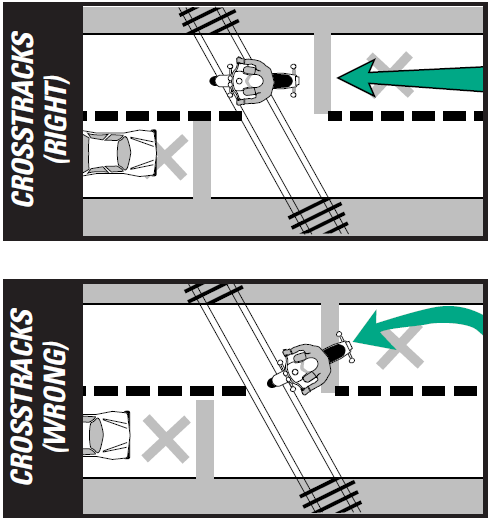
Usually it is safer to ride straight within your lane to cantankerous tracks. Turning to take tracks head-on (at a xc° angle) can be more unsafe - your path may deport yous into another lane of traffic.

For rails and road seams that run parallel to your course, move far plenty away from tracks, ruts, or pavement seams to cross at an angle of at least 45°. Then, make a quick, precipitous plow. Edging beyond could catch your tires and throw you off balance.
Grooves and Gratings

Riding over rain grooves or bridge gratings may cause a motorcycle to weave. The uneasy, wandering feeling generally is not hazardous. Relax, maintain a steady speed and ride straight across. Crossing at an angle forces riders to zigzag to stay in the lane. The zigzag is far more hazardous than the wandering feeling.
TEST YOURSELF
9. When information technology starts to rain it is usually all-time to:
A. Ride in the center of the lane.
B. Pull off to the side until the rain stops
C. Ride in the tire tracks left by cars.
D. Increase your speed.
Answer
Mechanical Problems
Yous can detect yourself in an emergency the moment something goes wrong with your motorcycle. With any mechanical problem, take into account the road and traffic conditions you face. Here are some guidelines that can help you handle mechanical problems safely.
Tire Failure
Y'all volition seldom hear a tire go flat. If the motorcycle starts to handle in a dissimilar manner, it may exist a tire failure. This can exist dangerous. You must be able to tell from the way the motorcycle reacts. If one of your tires suddenly loses air, react quickly to go on your residual. Pull off and check the tires. If the front tire goes flat, the steering volition feel "heavy." A frontwheel flat is particularly hazardous considering it affects how y'all steer. Y'all have to steer well to keep your balance. If the rear tire goes flat, the back of the motorbike may jerk or sway from side to side.
If either tire goes flat while riding:
- Hold handlegrips firmly, ease off the throttle, and keep a straight form.
- If you must brake, however, gradually apply the brake of the tire that is not apartment, if you are sure which one it is.
- When the motorcycle slows, border to the side of the route, squeeze the clutch and cease.
Stuck Throttle
Twist the throttle back and forth several times. If the throttle cable is stuck, this may free it. If the throttle remains stuck immediately operate the engine cut-off switch and pull in the clutch at the aforementioned time. This will remove power from the rear wheel, though engine dissonance may not immediately reject. Once the motorbike is "under control," pull off and cease.
After you have stopped, check the throttle cable carefully to find the source of the trouble. Make certain the throttle works freely before you lot outset to ride once again.
Wobble
A "wobble" occurs when the front end cycle and handlebars start to shake suddenly from side to side at any speed. Most wobbles can be traced to improper loading, unsuitable accessories or incorrect tire pressure. If you have a heavy load, lighten it. If yous cannot, shift it. Center the weight lower and further frontwards on the motorcycle. Brand sure tire force per unit area, spring pre-load air shocks and dampers are at the settings recommended for that much weight. Make sure windshields and fairings are mounted properly. Bank check for poorly adjusted steering; worn steering parts; a front wheel that is bent, misaligned, or out of balance; loose wheel bearings or spokes; and swing arm bearings. If none of these are determined to be the cause, have the motorcycle checked out thoroughly past a qualified professional. Trying to "accelerate out of a wobble" will just make the motorcycle more than unstable. Instead:
- Grip the handlebars firmly, but do not fight the wobble.
- Shut the throttle gradually to slow downward. Do not apply the brakes; this could make the wobble worse.
- Motion your weight as far forrad and down as possible.
- Pull off the road as soon as you tin to fix the problem.
TEST YOURSELF
10. If your motorcycle starts to wobble:
A. Accelerate out of the wobble.
B. Use brakes gradually.
C. Grip the handlebars firmly and close the throttle gradually.
D. Downshift.
Answer
Chain Problems
A chain that slips or breaks while y'all operate the motorcycle could lock the rear wheel and cause your cycle to slip. Chain slippage or breakage tin can exist avoided by proper maintenance.
Slippage —If the concatenation slips when you try to speed up quickly or ride uphill, pull off the road. Check the chain and sprockets. It may aid to tighten the chain . If the problem is a worn or stretched chain or worn or bent sprockets, replace the chain, the sprockets or both before riding again.
Breakage — You will find an instant loss of ability to the rear wheel. Shut the throttle and brake to a cease.
Engine Seizure
When the engine "locks" or "freezes" information technology is normally depression on oil. The moving parts of the engine cannot move smoothly against each other, and the engine overheats. The first sign may be a loss of engine power or a modify in the engine audio. Squeeze the clutch lever to disengage the engine from the rear wheel. Pull off the road and stop. Check the oil. If needed, oil should be added as soon as possible or the engine volition seize. When this happens, the effect is the same every bit a locked rear wheel. Permit the engine cool before restarting.
Animals
Naturally, you should exercise everything yous safely tin can to avert a collision with an animal. If you are in traffic, however, remain in your lane. A standoff with a small animate being is less dangerous to you than a collision with big fauna or object—like a automobile. Motorcycles seem to attract dogs. If y'all are chased, downshift and arroyo the fauna slowly. As you lot approach it, accelerate abroad and leave the fauna behind. Practise non kicking at an animate being. Continue control of your motorbike and look to where y'all want to get.
For larger animals (deer, elk, cattle) restriction and prepare to stop, they are unpredictable.
Exam YOURSELF
xi. If you are chased by a dog:
A. Kick it away.
B. Stop until the animal loses interest.
C. Swerve effectually the fauna.
D. Approach the animal slowly, and then speed up.
Respond
Flying Objects
From time to time riders are struck past insects, cigarettes thrown from cars or pebbles kicked up past the tires of the vehicle ahead. If yous are wearing face protection, it might go smeared or cracked. This makes it hard to see. Without face protection, an object could hitting y'all in the eye, face or mouth. Whatever happens, keep your eyes on the road and your easily on the handlebars. When rubber, pull off the road and repair the harm.
How to Get Off the Road
If you demand to go out the road to check the motorcycle (or just to rest for a while), be sure you lot:
- Cheque the roadside—Make sure the surface of the roadside is firm plenty to ride on. If it is soft grass, loose sand, or if you are just not sure nearly information technology, irksome mode downward before you plow onto it.
- Indicate—Drivers backside might non expect you to ho-hum down. Requite a articulate signal that you will tedious down and change direction. Bank check your mirror and brand a caput cheque before you accept any action.
- Pull off the route—Get as far off the road every bit you can. It tin exist very hard to spot a motorcycle by the side of the road. Yous practise not want someone else to pull off at the same place you are.
- Park carefully—Loose and sloped shoulders tin can make setting the side or heart stand difficult.
How to Carry Passengers and Cargo
Only experienced riders should carry passengers or large loads. The extra weight changes the way the motorcycle handles, balances, turns, speeds up and slows downwards. Before y'all take a passenger or heavy load on the street, practice away from traffic.
Equipment
To acquit passengers safely:
- Equip and accommodate your motorcycle to carry passengers.
- Instruct the passenger before you starting time.
- Adjust your riding technique for the added weight.
Equipment should include:
- A proper seat — large plenty to concord both of you without crowding. You should non sit whatever further forward than you normally do.
- Pes rests — for the rider.Firm footing prevents your passenger from a fall off the cycle, which could perhaps pull you off too.
- Protective equipment — the same protective gear recommended for operators.
Adjust the interruption to handle the boosted weight. You volition probably need to add a few pounds of force per unit area to the tires if you carry a rider. (Check your owner's manual for appropriate settings.) While your passenger sits on the seat with yous, adjust the mirror and headlight co-ordinate to the alter in the motorbike's angle.
How to Instruct Passengers
Even if your rider is a motorcycle rider, provide complete instructions earlier you lot start. Tell your passenger to:
- Get on the motorbike only later on you have started the engine.
- Sit equally far forrad as possible without crowding you.
- Hold firmly to your waist, hips, or belt.
- Keep both feet on the pegs, even when stopped.
- Keep legs away from the muffler(s), bondage or moving parts.
- Stay direct backside you lot, and lean every bit you lean.
- Avoid unnecessary talk or move.
- Also, tell your rider to concur more than tightly when yous:
- Approach surface problems.
- Are about to start from a stop.
- Warn that yous volition make a sudden move.
TEST YOURSELF
12. Passengers should:
A. Lean as you lot lean.
B. Hold on to the motorbike seat.
C. Sit as far back as possible.
D. Never agree onto you.
Answer
When You Ride With Passengers
Your motorbike will respond more slowly with a passenger on board. The heavier your passenger, the longer it will accept to ho-hum down, speed up, or plow—peculiarly on a light motorcycle.
- Ride a fiddling slower, peculiarly when taking curves, corners, or bumps.
- Start slowing before every bit y'all approach a stop.
- Open up up a larger cushion of infinite ahead and to the sides.
- Look for larger gaps to cross, enter, or merge in traffic.
Warn your rider of special conditions—when y'all will pull out, stop rapidly, turn sharply or ride over a bump. Plow your head slightly to brand yourself understood, just keep your optics on the road ahead.
When You Carry Loads
Most motorcycles are not designed to carry much cargo. Pocket-size loads tin be carried safely if positioned and attached properly.
- Keep the Load Low—Fasten loads deeply or put them in saddle numberless. Piling loads confronting a sissy bar or frame on the back of the seat raises the motorcycle's center of gravity and disturbs its balance.
- Proceed the Load Forward—Identify the load over, or in front of, the rear axle. Tank numberless keep loads forward, simply apply caution when you load hard or sharp objects. Make sure the tank bag does not interfere with the handlebars or controls. When you put loads behind the rear axle, it can affect how the motorcycle turns and brakes. It tin also crusade a wobble.
- Distribute the Load Evenly—Load saddlebags with about the same weight. An uneven load can cause the motorcycle to drift to 1 side.
- Secure the Load—Fasten the load deeply with elastic cords (bungee cords or nets). Elastic cords with more than i attachment point per side are more secure. A tight load will not take hold of in the wheel or concatenation, which tin can crusade it to lock up and slip. Rope tends to stretch and knots come loose, which permits the load to shift or fall.
- Cheque the Load—Stop and check the load every so ofttimes to make sure it has non worked loose or moved.
Group Riding
If you ride with others, do it in a way that promotes safety and doesn't interfere with the catamenia of traffic.
Keep the Group Small-scale
Small groups get in easier and safer for car drivers who need to go around them. A small number isn't separated as easily past traffic or carmine lights. Riders will not e'er be hurrying to catch up. If your group is larger than 4 or five riders, split up it upwards into ii or more than smaller groups.
Keep the Group Together
- Plan — The leader should look alee for route changes and signal early so "the word gets back" in plenty of time. Start lane changes early to permit everyone to complete the alter.
- Put Beginners Up Front end — Place inexperienced riders just behind the leader. That way the more experienced riders can watch them from the back.
- Follow Those Backside — Permit the tailender prepare the pace. Use your mirrors to keep an eye on the person behind. If a rider falls behind, anybody should slow downward a little to stay with that rider.
- Know the Route — Brand sure anybody knows the road. And so, if someone is separated they will not accept to hurry to keep from getting lost or taking a incorrect turn. Plan frequent stops on long rides.
Continue Your Distance
Maintain close ranks but at the same fourth dimension keep a prophylactic altitude to let each rider in the group time and infinite to react to hazards. A close group takes upwards less space on the highway, is easier to meet and is less probable to be separated. Notwithstanding, it must be done properly.
Don't Pair Upward—Never operate directly aslope another rider. At that place is no place to go if you lot have to avoid a car or something on the road. To talk, expect until yous are both stopped.
Staggered Formation
This is the best style to keep ranks close yet maintain an adequate space cushion. The leader rides in the left side of the lane, while the second rider stays 1 second backside in the right side of the lane.

A tertiary rider maintains in the left position, 2 seconds behind the first rider. The 4th passenger would go on a 2-second distance backside the second passenger. This germination keeps the group close and permits each passenger a safety distance from others alee, behind and to the sides.
- Passing in Formation—Riders in a staggered formation should pass ane at a time.
- First, the atomic number 82 rider should pull out and pass when it is safe. Later passing, the leader should return to the left position and continue at passing speed to open room for the next rider. After the offset rider passes safely, the second rider should motion up to the left position and sentry for a condom take chances to laissez passer. After passing, this passenger should return to the right position and open upward room for the next rider. Some people suggest the leader should move to the correct side afterwards passing a vehicle. This is not a good thought. It encourages the 2nd rider to pass and cutting back in before there is a large plenty infinite cushion in front of the passed vehicle. Information technology is simpler and safer to wait until there is enough room ahead of the passed vehicle to let each rider to move into the aforementioned position held earlier the pass.
Single-File Germination
It is best to move into a single-file formation when riding curves, turning, entering or leaving a highway.

Afterwards the offset rider passes safely, the 2d rider should move up to the left position and watch for a safe chance to pass. After passing, this rider should return to the right position and open up room for the next rider.

TEST YOURSELF
13. When riding in a group, inexperienced riders should position themselves:
A. Just behind the leader.
B. In front end of the group.
C. At the tail end of the group.
D. Beside the leader.
Answer
Source: https://dmv.ny.gov/driver-training/motorcycle-manual-ride-within-your-abilities
0 Response to "When Can a Motorcyclist Use a Complete Traffic Lane?"
Postar um comentário